Skip to the content

From imagination to animation · waitlist open

Describe a creature. Get it rigged, animated and ready for your game.

You describe it in a chat. Animo3D draws the concept, builds the 3D model, gives it a skeleton with hands that hold, and animates it. Every clip is measured before you see it.

One message, when it opens. Your address is kept for that and nothing else.

01 What is possible

The kind of game this makes possible.

These are not videos. Each scene is the models themselves, playing their clips in your browser.

A top-down action RPG or MMORPG

Characters made for a fight seen from above.

A top-down action RPG hides nothing. The camera looks down on the whole fight, and every character turns, strikes, takes a hit, falls and gets back up in full view. Each needs a real 3D model, a skeleton, and a clip for everything it does. Animo3D makes all three from a written description.

Animo3D makes the character and its clips. When each one plays is your game.

A side-scrolling platformer

A hero, an enemy, a block and a coin.

A platformer asks for less of each model and more of the set. The hero runs, jumps, bumps a block from below and comes down on an enemy; the enemy walks and is flattened; the block and the coin need no clip at all. Two characters and three props, in one style, each made from its own description.

Every model and every clip in this level came out of the pipeline. The level itself is a page of code.

A farming or village game

Animals that walk, feed, root in the earth and lie down.

Not everything in a game fights. A four-legged animal needs its own skeleton and its own way of walking, and eating is three clips that join: the head goes down, the eating loops for as long as the game likes, the head comes up. Rooting in the soil is a fourth that fits between the same two, and lying down is three more made the same way. Around it, a paddock is a handful of props in one style, each made from its own description, the grass and the ground set out many times.

One animal and its nine clips, and nine props, all out of the pipeline. Where they stand is a page of code.

A lane battle for phones

A whole board and the units that fight on it.

A lane battle is played on one tall screen, seen from far above, so everything on it has to read at the size of a thumbnail: big heads, thick limbs, clear colours. Each unit needs four clips to take part, an idle, a walk, an attack and a death, and the board is a handful of props in one painted style set out many times. All of it here is the light version made for phones.

Four units with four clips each, and nine props, all out of the pipeline. The lawn is plain ground and the red side is the blue towers painted over. The health bars, the bolts from the towers and who wins are a page of code.

02 How it works

From a sentence to a character that moves, in six steps.

Each step that costs something waits for your yes. Nothing is made twice because a later step failed.

  1. Say what you want in plain words, in a chat. The assistant works out the details with you and writes the concept.

    You: An orc kennelmaster for a desert stronghold. Compact and hunched, one chipped tusk, a big bite gauntlet on his left arm, cage keys at his hip. Leaning forward, hook held low.

    Assistant: His concept is ready to draw. Three changes from your brief, so he can be modelled and rigged:

    • Arms out in a standard pose on a plain background, not leaning.
    • The herding hook is its own prop. His hands are empty.
    • Keys and whistle drawn big and chunky, so they hold up as a model.
    Orc KennelmasterChunky Hand-Painted Fantasy
    Draw
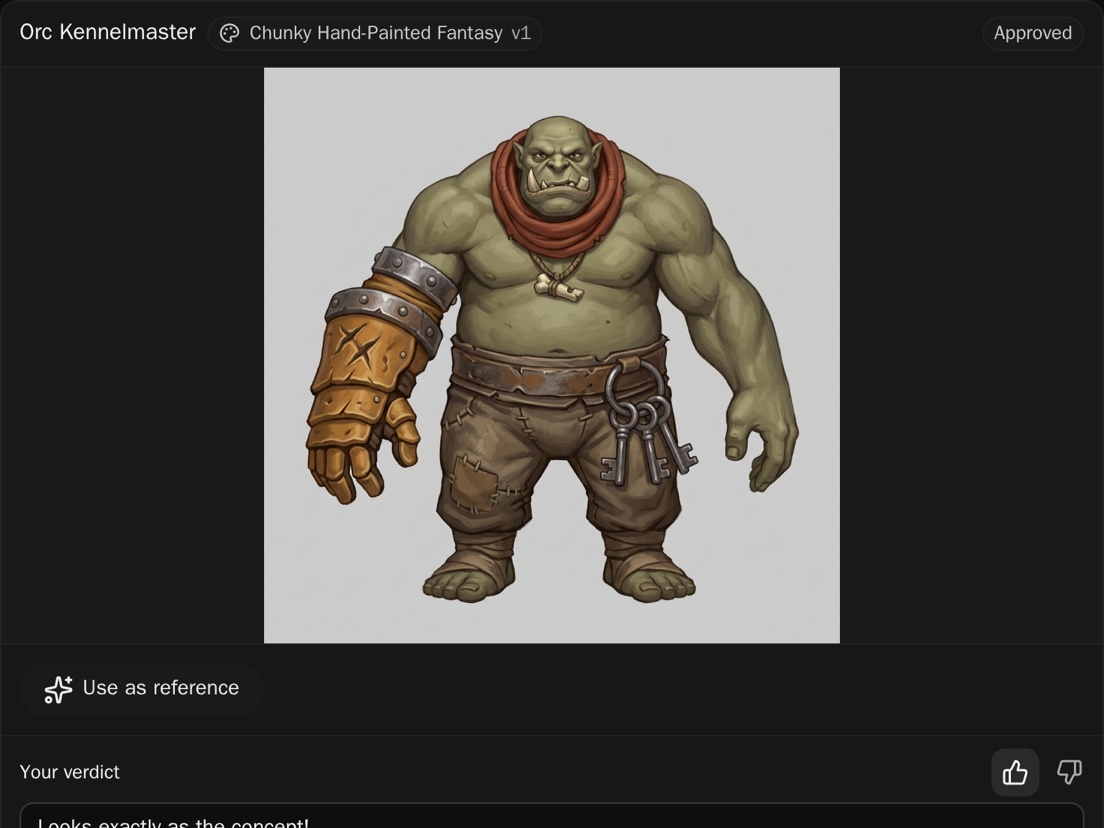
  2. It is drawn in your art style, in the pose a rig needs. You approve it, or ask again.

    The drawn concept of the orc, standing with his arms away from his body, marked approved.
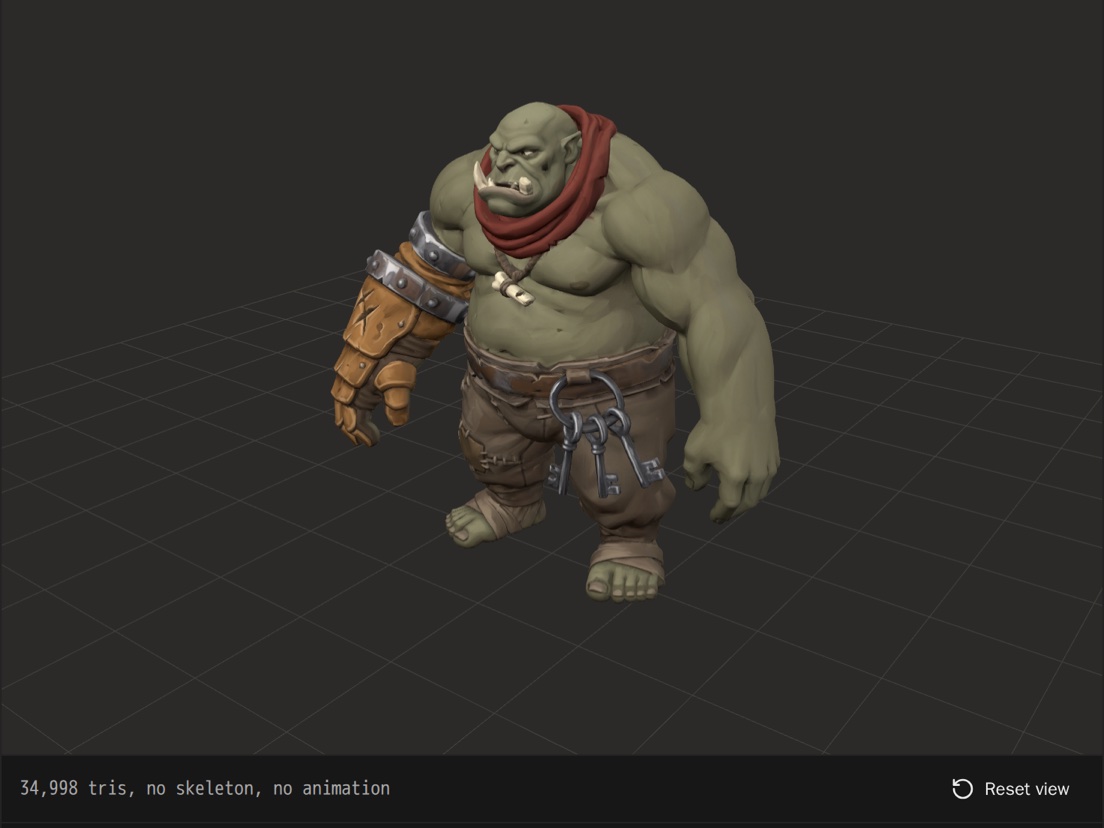
  3. The 3D model is built from the picture. It is trimmed to a game budget: 35,000 triangles for a character.

    The orc as a 3D model in a viewer: 34,998 triangles, no skeleton, no animation.
  4. It is given a skeleton and skin weights: a bone chain for every finger, and a grip bone in each hand for what it holds.

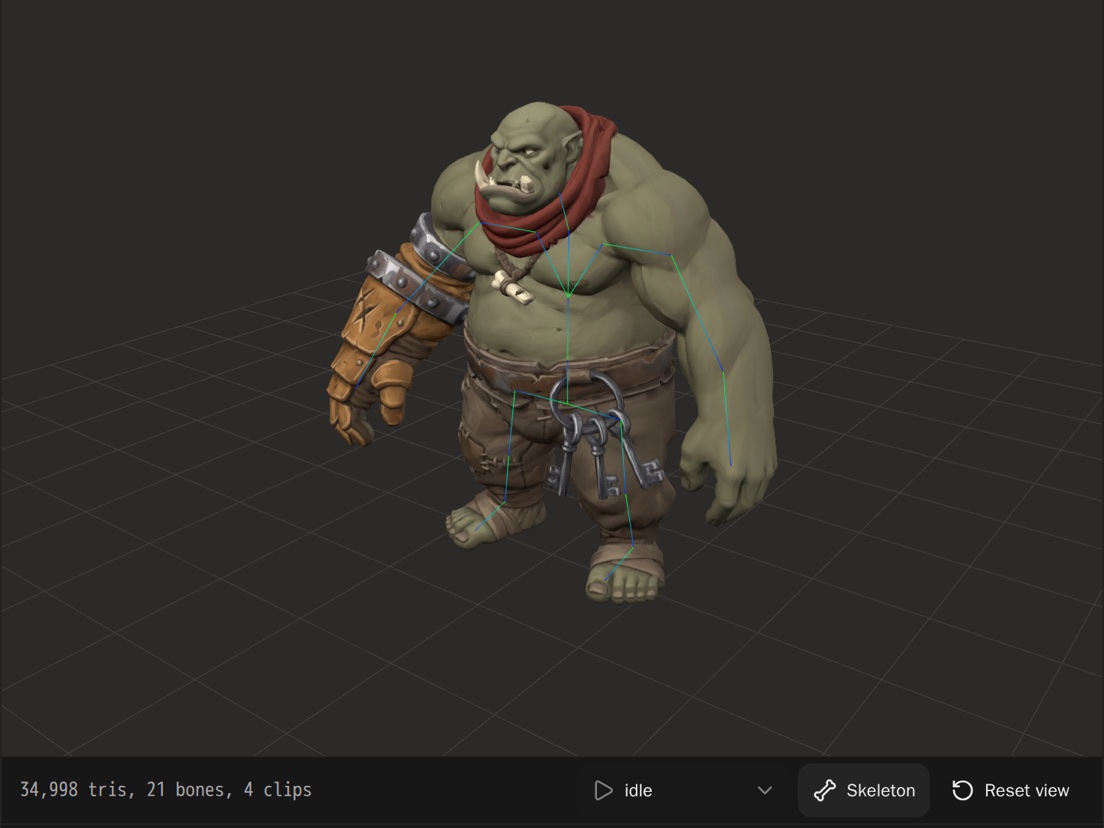
    The same model with its skeleton drawn through it: 21 bones.
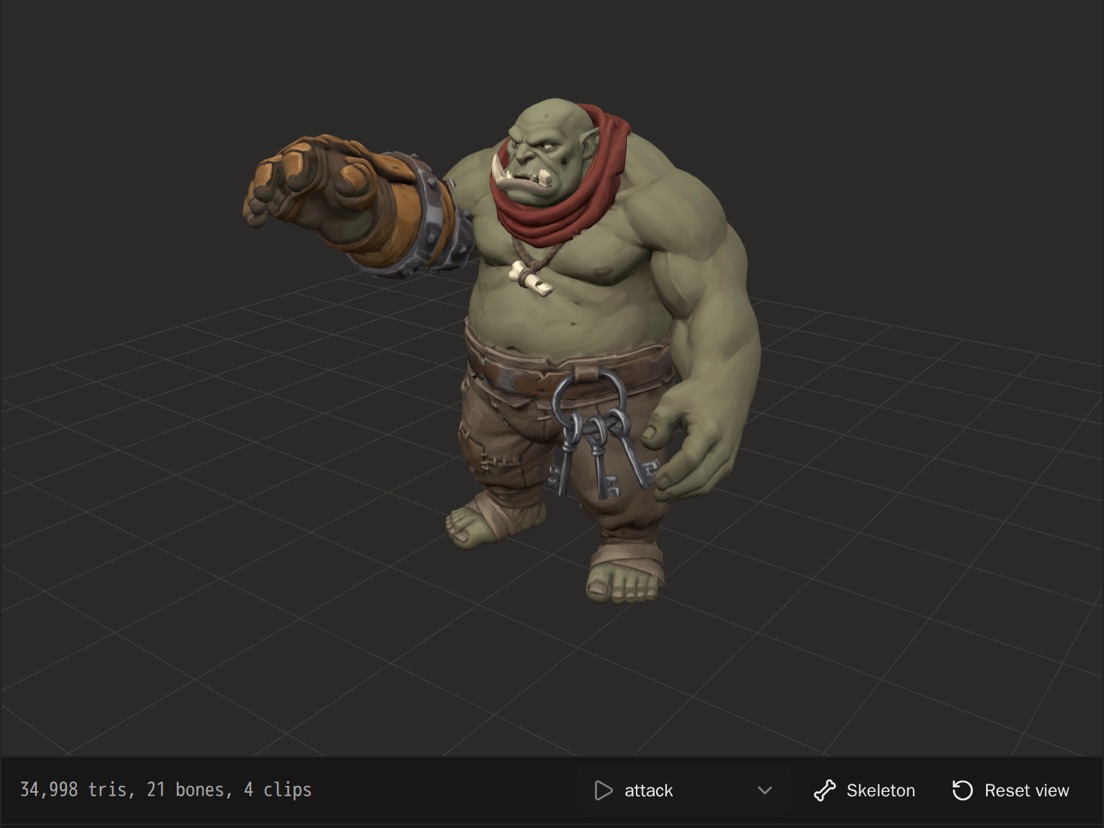
  5. Ask for a clip in words: a walk, a dash, a block, a kick. Each is made from a written playbook and added to the same file.

    The orc in the middle of his attack clip, his gauntlet thrown forward.
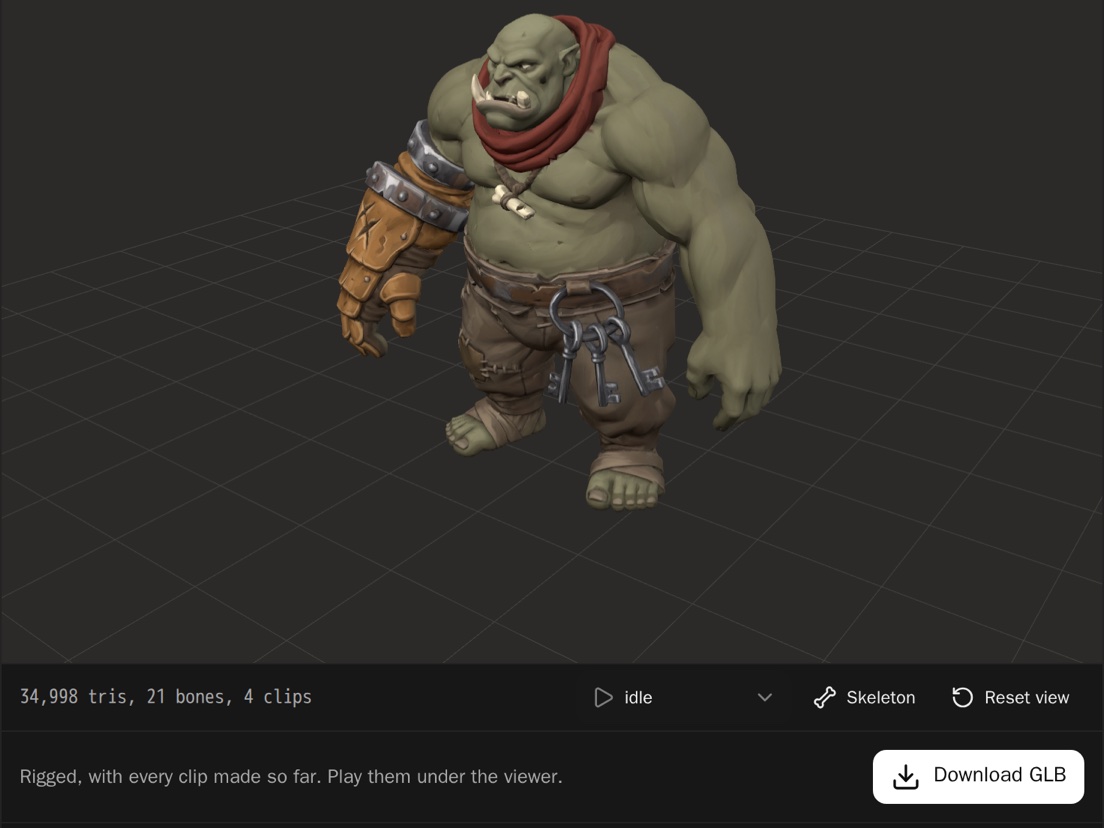
  6. You get one GLB file: mesh, texture, skeleton and every clip. Drop it into your engine.

    • Godot

    Opened in Godot 4.3 with every bone and clip in place. GLB is the open glTF 2.0 format. Unity and Unreal Engine have importers for it; we have not tried our files in them yet.

    The finished model with its clips and a button to download it as a GLB file.

03 Animations

Ask for a movement in words. It knows how each one is done.

Behind every clip is a written playbook: how long it lasts, which part leads, how far each joint turns, what goes wrong. They are measured from hand-made animation and corrected every time a clip comes out wrong.

Moving about

  • Walk, run and sprint
  • Dash
  • Jump
  • Platformer run and jump
  • Four-legged walk and run

Attacks

  • Melee attack and punch
  • Combo
  • Kick
  • Ground slam
  • Throw
  • Creature attack

Defending

  • Block
  • Dodge and roll

Reactions

  • Hit reaction
  • Stunned
  • Death
  • Get up

Character

  • Idle
  • Taunt
  • Grazing

04 Checks

Measured before it reaches you, not hoped for.

Generated animation breaks models in ways a still picture hides: a shoulder that rips, a hand inside a belly, a body about to fall over. Each of those has a number here, and a clip that fails one is made again.

  • 6×

    It does not tear

    Every clip is measured for how far it pulls the surface. One that stretches any part past six times its resting length is thrown back and made again.

  • 0

    Hands stay outside the body

    Rays against the posed model find a hand or forearm inside the belly, the chest, a thigh or an arm. A clip with one there fails.

  • 90°

    Shoulders are tested before a clip is made

    A finished rig has each arm turned 90 degrees and each leg 70, and the strain on the surface measured, so a weak shoulder is fixed while it is still cheap.

  • 5%

    It keeps its balance

    The head must stay over the feet unless you asked for a stagger or a fall. A body whose head comes within 5 percent of its height of the back of its heels is caught.

05 Packs

Characters made in the studio, ready to drop in.

Not everyone wants to make their own. Packs are sets of rigged, animated characters built with the same pipeline and checked the same way. The shelf is being stocked.

Orc pack

In the making

A warband of thirteen: eight orcs on foot, their giant warlord, a captain on a war beast, and three beasts. Each is rigged and animated, and they are made to be used together. Twenty-seven props dress their camp.

  • Thirteen characters, 138 clips between them
  • Each one idles, walks, runs, takes a hit and dies, and has attacks of its own
  • Twenty-seven props for their camp, from a tent to a forge
  • One GLB file per character, clips inside
  • Every file opened in Godot 4.3 with each bone and clip in place

06 Questions

Plain answers.

What it is, what you get, and what it is not yet.

What is Animo3D?

Animo3D is a tool that turns a written description into a rigged, animated 3D game character. You describe a creature in a chat. It draws a concept picture, builds a 3D model from it, trims the model to a game budget, gives it a skeleton and makes animation clips. The result is one GLB file.

What exactly do I get?

A GLB file (glTF 2.0) holding the mesh, its texture, a skeleton with skin weights, and every animation clip you asked for. A humanoid character has a bone chain for each finger it has, and a grip bone in each hand that a weapon or tool attaches to.

Which game engines can use it?

GLB is the open glTF 2.0 format. Our own files were opened in Godot 4.3 with every bone and clip in place, and Animo3D is built with Godot in mind first. Unity and Unreal Engine have importers for the format; we have not tried our files in them yet.

How is this different from a text-to-3D generator?

A text-to-3D generator gives you a still mesh. Animo3D goes on from there: it rigs the mesh with a skeleton, makes animation clips for it, and measures each result before accepting it. A still mesh needs a technical artist before it can move in a game. This is that work.

How do you stop generated animations from breaking the model?

Every clip is checked by measurement, not by eye alone. A clip fails if it stretches the surface past six times its resting length, or if a hand or forearm ends up inside the body. It is flagged if the body leans back past its heels without being asked to. A rig has its shoulders and hips turned and measured before any clip is made on it.

Does AI make the animations?

Yes. An AI agent rigs and animates each model. It works from written playbooks, one for each kind of movement, with timings and angles measured from hand-made clips. Its work is judged by our own checks, never by its own word, and a person approves every paid step.

Can a character hold a weapon?

Each hand is rigged with fingers that close and a grip bone placed in the palm, turned so a handle lies along it. A held thing, such as a sword or a shield, is made as its own model and attaches to that bone in your engine.

What kinds of animation can it make?

There are playbooks for twenty kinds of movement so far: idle, walk, run and sprint, dash, jump, run and jump in parts for a platformer, melee attack and punch, combo, kick, ground slam, throw, block, dodge and roll, hit reaction, stunned, death, get up, taunt, and attacks, gaits and grazing for four-legged creatures.

What are packs?

Packs are sets of animated characters made in the studio and offered ready to use. The first is an orc pack of thirteen characters with 138 animation clips between them, and twenty-seven props for their camp. Each character is one GLB file with its mesh, textures, skeleton and clips, and every one has Idle, Walk, Run, Hit_Reaction and Death under those names. All thirteen files were opened in Godot 4.3. It is still being made, and no price has been announced.

Is Animo3D available now?

Not yet. It is in use inside the studio that builds it. Join the waitlist and you will be told when it opens. No price has been announced.

What do you do with my email address?

It is kept only to tell you when Animo3D opens. With it we store what you said you make, if you chose to say, and the date. Nothing else is recorded, it is not shared with anyone, and it is deleted when you ask.
07 · Waitlist

From imagination to animation.

Not open yet. Join the waitlist and we will tell you when it is.

One message, when it opens. Your address is kept for that and nothing else.

From imagination to animation. · 2026

The waitlist keeps your email address, what you said you make, and the date. Nothing else, shared with no one, deleted when you ask. Godot logo by Andrea Calabró, CC BY 4.0, shown in one colour.